
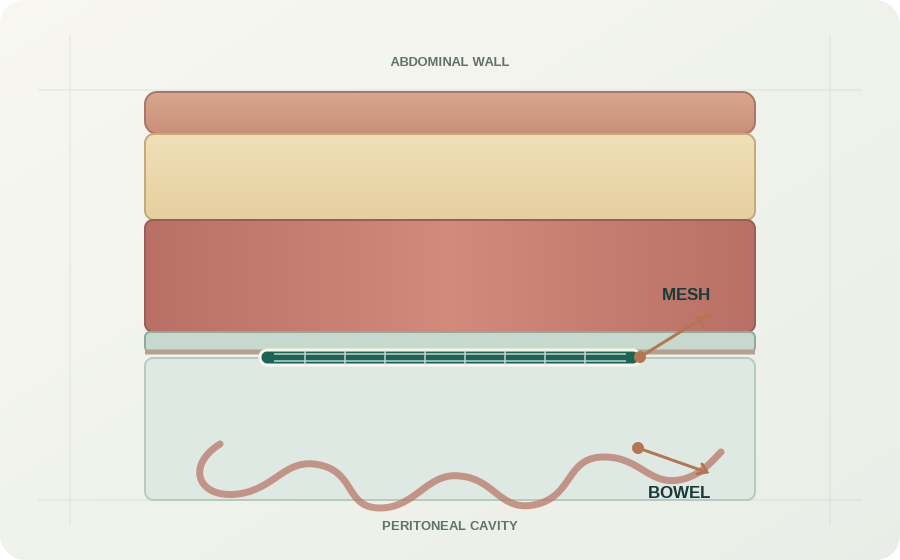
IPOM is a laparoscopic method for repairing selected ventral or incisional hernias. The mesh is placed inside the abdominal cavity against the inner surface of the abdominal wall, so a mesh designed for intraperitoneal use and its relationship to the bowel and other organs must be carefully considered. It is an option for selected cases, not the right choice for everyone.
How is the operation performed?
-
Laparoscopic access and hernia assessment
The operation is usually performed under general anaesthesia. A camera and instruments are introduced through small ports, and the defect, its contents and the inner abdominal wall are assessed. Previous operations, imaging and the possibility of adhesions are considered during planning.
-
Adhesiolysis and reduction of the hernia contents
If adhesions are present, the surgeon releases only what is needed to obtain safe access to the planned mesh landing area, avoiding unnecessary extensive dissection. Hernia contents are reduced, and the bowel is carefully checked when indicated, particularly after adhesiolysis.
-
Assessing and closing the defect when appropriate
The defect is assessed and the surgeon considers whether the fascial edges can be brought together without undue tension. In selected cases the defect is closed before mesh placement; this is called IPOM-plus. Closure is not feasible or appropriate in every case, and the plan depends on defect size, tissue quality and the individual patient.
-
Positioning the mesh, fixation and completion
A mesh specifically designed for intraperitoneal use is positioned with its designated barrier surface facing the viscera and with appropriate overlap beyond the defect. The surgeon selects fixation according to the mesh, its instructions for use and the anatomy. Mesh position and visceral safety are checked before the ports are closed.
What does IPOM mean?
IPOM stands for Intraperitoneal Onlay Mesh. A surgical mesh is placed inside the peritoneal cavity against the inner surface of the abdominal wall. This differs from retromuscular or preperitoneal placement: in IPOM the mesh lies within the abdominal cavity, close to the viscera, so its design and selection require particular care.
What is the difference between IPOM and IPOM-plus?
In conventional IPOM, the defect may be covered by mesh without closing its fascial edges. IPOM-plus adds fascial defect closure before mesh reinforcement. When closure is feasible and safe, it may help restore abdominal-wall continuity and reduce bulging or seroma in some cases. It is not suitable for every defect and does not guarantee that recurrence will not occur.
Who may be considered for IPOM?
IPOM may be discussed for selected umbilical, ventral or incisional hernias after considering defect size and location, symptoms, previous operations, likely adhesions, bowel condition and general risk factors. The decision also depends on whether the defect can be closed, the team’s expertise and the availability of suitable alternatives. Having a hernia does not automatically make IPOM the best option.
How is the mesh selected?
Not every mesh is suitable for placement inside the abdominal cavity. An intraperitoneal mesh is selected, commonly with a surface or barrier designed to reduce bowel attachment. The correct surface must face the viscera in accordance with the manufacturer’s instructions. These barriers may reduce risk, but they do not completely eliminate adhesions or late complications.
What are the potential advantages?
The laparoscopic approach provides access to the inner abdominal wall through small ports and may be useful in selected cases or when some extraperitoneal planes are difficult or unsuitable. Actual benefits vary with the patient, technique and surgeon’s experience. Small incisions do not automatically mean a lower-risk operation or faster recovery for every patient.
Risks and longer-term considerations
Potential risks include bleeding, infection, seroma, pain, recurrence or a hernia at a laparoscopic port site. Bowel injury can occur during adhesiolysis. Adhesions between the viscera and mesh may still develop despite a purpose-designed barrier and can contribute to bowel obstruction or make future abdominal surgery more complex. The risks vary between patients and should be discussed before surgery.
IPOM or retromuscular repair?
Alternatives place mesh outside the abdominal cavity, such as retromuscular or preperitoneal repair using open, laparoscopic or robotic techniques. The 2023 European Hernia Society guideline recommends a retromuscular mesh position for many midline incisional hernias in which the defect can be closed without advanced component separation, and advises caution with mesh exposed to the viscera because of potential long-term issues, particularly during future abdominal surgery. That plane may not be possible or appropriate in every case, so the decision must be individualised.
Preparation and pre-operative planning
Planning includes review of previous operations, medicines, allergies and medical conditions, as well as examination of the abdominal wall. The surgeon may request a CT scan to define the defect, its contents and its relationship to the muscles, tissues and previous operative sites. Optimising diabetes, stopping smoking, improving weight, nutrition and fitness may help reduce risk. Do not stop any medicine, particularly blood thinners or diabetes medicines, without instructions from your clinical team.
Recovery and when to seek medical help
Temporary pain, tightness, bruising or swelling may occur around the hernia or port sites. Hospital stay and return to work, movement and lifting depend on the extent of repair, general health, type of work and the surgeon’s instructions; there is no single timeline for everyone. Seek urgent assessment for severe or worsening abdominal pain, persistent vomiting, increasing distension, inability to pass wind or stool, fever, or increasing wound redness or discharge. Breathlessness or chest pain requires emergency care.
Frequently asked questions
Is IPOM mesh placed behind the abdominal muscles?
No. In IPOM the mesh is placed inside the peritoneal cavity against the inner abdominal wall. Retromuscular repair places mesh outside the abdominal cavity in a different anatomical plane.
Does the mesh touch the bowel?
The mesh lies inside the abdominal cavity facing the viscera, so a mesh designed for this position with a barrier surface is used to reduce adhesion. The barrier does not completely eliminate the possibility of adhesions or late complications.
What is IPOM-plus?
It means closing the fascial defect first and then reinforcing the area with intraperitoneal mesh. This may be appropriate when the edges can be safely approximated without undue tension, but it is not feasible or suitable in every case.
Is IPOM the best technique for every ventral hernia?
No. Other techniques place mesh outside the abdominal cavity, and guidelines favour retromuscular placement for many midline incisional hernias. The choice depends on the hernia, previous operations, general health and the team’s expertise.
Does a barrier-coated mesh prevent adhesions completely?
No. The barrier surface is designed to reduce adhesion of the viscera to the mesh, but it cannot guarantee prevention of adhesions, bowel injury or future obstruction. The surgeon should discuss these considerations when comparing options.
Will I need a CT scan, and how long is recovery?
The surgeon may request a CT scan to understand the defect and its contents and to plan the operation, particularly for some incisional hernias or after previous surgery. Recovery varies with the extent of repair, general health and type of work; your team will guide your gradual return to activity.
Selected references
- European Hernia Society — Midline incisional hernia guidelines (2023) ↗
- Burns et al. — Intraperitoneal versus retromuscular mesh placement: systematic review and meta-analysis (2026) ↗
- International Endohernia Society — Guidelines for laparoscopic treatment of ventral and incisional hernias, Part B (2019) ↗