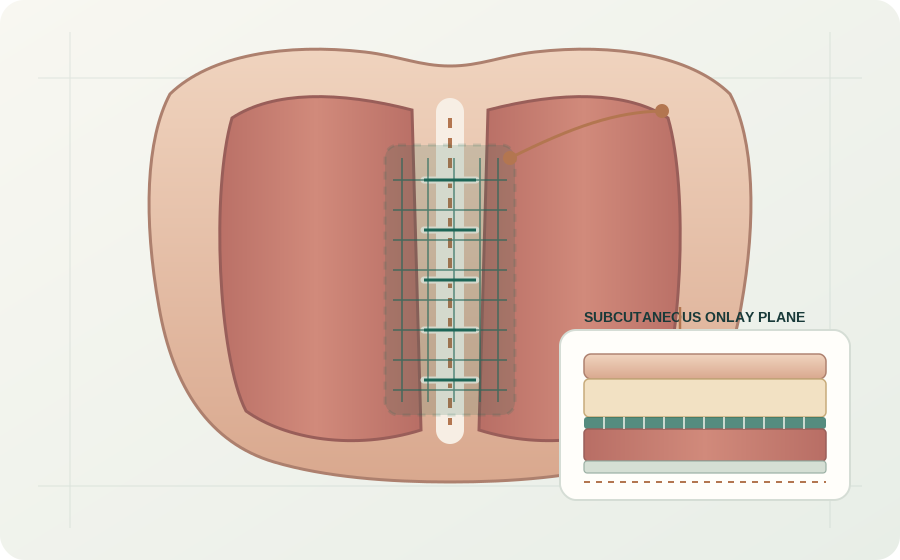
SCOLA stands for Subcutaneous Onlay Laparoscopic Approach. An endoscopic working space is developed beneath the skin and in front of the rectus sheath, and the linea alba is brought together with sutures to address rectus diastasis. If a small umbilical or epigastric hernia is also present, the defect may be repaired and anterior mesh reinforcement considered in selected cases. SCOLA is not suitable for every diastasis or hernia.
How is the operation performed?
-
Creating the subcutaneous working space
The operation is usually performed under general anaesthesia. Through small access incisions, the endoscope and instruments enter the plane between the skin and subcutaneous tissue on one side and the rectus sheath on the other. The extent of dissection and port positions vary with the patient and the surgeon’s plan.
-
Assessing the midline and any associated hernia
The extent of rectus diastasis is assessed, together with the presence, location and size of any umbilical or epigastric hernia. The surgeon also considers the skin, subcutaneous tissues and wound-healing risk factors, because the extent of subcutaneous dissection can influence seroma and wound-healing risks.
-
Plicating the midline and repairing a defect when needed
The edges of the linea alba or rectus sheath are brought together with sutures to restore the midline. If an associated hernia defect is present, it is closed or repaired as part of the individual plan. The suture method and extent of repair depend on the anatomy, defect size and the surgeon’s assessment.
-
Selective reinforcement and completion
In selected cases, the surgeon may place an onlay mesh on the front surface of the rectus sheath within the subcutaneous plane; other cases may not require mesh. The repair is checked, a drain may be used to manage fluid collection according to the surgeon’s judgement, and the small incisions are closed. The name of the technique does not mean that mesh is mandatory for every patient.
What does SCOLA mean?
The abbreviation stands for Subcutaneous Onlay Laparoscopic Approach. It uses an endoscopic subcutaneous plane and may include an onlay mesh on the front of the abdominal wall. It is intended to address rectus diastasis and may be combined with repair of a small midline hernia in selected cases. This is different from TAPP and TEP, which are generally used for inguinal hernia repair in the posterior preperitoneal plane.
Is rectus diastasis the same as a hernia?
No. Rectus diastasis is widening of the linea alba between the two rectus muscles; it does not necessarily mean that there is a hole or defect in the abdominal wall. A hernia involves an actual defect through which fat or abdominal contents may protrude. Diastasis and an umbilical or epigastric hernia can coexist, so each should be assessed separately.
Who may be considered for SCOLA?
SCOLA may be discussed for selected patients with rectus diastasis associated with symptoms, functional concerns or bothersome bulging, sometimes with a small accompanying umbilical or epigastric hernia. Appearance alone is not enough to make the decision. Assessment includes symptoms, the degree of separation, any hernia and its size, skin and tissue quality, previous operations and risk factors. Physiotherapy may be considered before surgery, depending on the circumstances.
What are the potential advantages?
The approach provides access to the midline through small incisions, allowing plication of the linea alba or rectus sheath and, when appropriate, repair of an associated midline hernia during the same operation. It may improve midline abdominal bulging in some patients. Functional and cosmetic results vary, and the procedure cannot guarantee elimination of every bulge, pain or area of loose skin.
Is mesh used in every case?
No. Plication without mesh may be used for some cases of diastasis without a hernia. When a midline hernia is also present, European Hernia Society guidance suggests mesh-based repair in many cases, while plication alone may be sufficient for some very small defects under 1 cm. These recommendations are based on limited-quality evidence. The surgeon determines whether mesh is needed and, if so, its type and position after assessing the individual case.
Risks and limitations to discuss
Seroma, a collection of fluid beneath the skin, is a recognised complication after this type of subcutaneous dissection. Infection, haematoma, delayed wound healing, temporary or persistent changes in skin sensation, pain, and recurrence of the diastasis or hernia may also occur. Less commonly, skin blood supply may be affected or skin injury may develop. Risks vary with the extent of dissection, tissue quality, patient factors and the team’s experience.
How does it differ from abdominoplasty and other options?
SCOLA focuses on the subcutaneous plane and midline plication, and may include repair of a midline hernia. Abdominoplasty primarily removes excess skin and reshapes the abdomen, and may be combined with abdominal wall repair in selected cases. Open and other endoscopic approaches are also available. No single method suits everyone, and current evidence does not establish SCOLA as superior to all alternatives.
How should you prepare?
Pre-operative review includes assessment of symptoms, the degree of diastasis and any associated hernia, as well as medical history, previous operations, medicines, allergies, smoking, diabetes and wound-healing risk factors. Tell the team about all medicines, especially blood thinners and diabetes medicines. Do not stop prescribed medication on your own; follow the surgeon’s and anaesthetist’s instructions about medicines and fasting.
Recovery and when to seek medical help
Tightness, pain, bruising or swelling may occur, and a seroma may develop beneath the skin during recovery. Your surgeon may recommend a binder, a drain or additional follow-up depending on the procedure; there is no single recovery plan for everyone. Resume movement gradually and follow the wound-care and activity instructions. Seek urgent medical assessment for fever, severe or worsening pain, increasing wound redness or discharge, rapidly increasing swelling or persistent vomiting. Seek emergency care for breathlessness or chest pain.
Frequently asked questions
Does rectus diastasis mean that I have a hernia?
No. Diastasis is widening of the linea alba between the muscles, whereas a hernia involves a defect or opening in the abdominal wall. They can coexist; examination and imaging when needed help determine whether a hernia is also present.
Is SCOLA suitable for everyone with abdominal bulging?
No. Bulging may be related to diastasis, a hernia, fat, excess skin or other causes. Assessment is needed to identify the cause before discussing non-operative care and suitable surgical options.
Does SCOLA always require mesh?
No. Plication without mesh may be used in some cases, while mesh reinforcement may be advised when a midline hernia is also present. The decision depends on defect size, anatomy and patient factors; the benefits and risks of mesh should be discussed with the surgeon.
What is a seroma?
A seroma is a collection of fluid beneath the skin in the area that was dissected. A small, symptom-free collection may simply be monitored; some cases need ultrasound assessment or drainage. Do not try to treat it yourself; follow your clinical team’s advice.
Does SCOLA remove excess skin like abdominoplasty?
No. SCOLA focuses on midline plication and repair of an associated hernia when needed; it does not, by itself, remove excess skin. Abdominoplasty is a different procedure and may be discussed separately or in combination in selected cases.
When can I return to work and exercise?
Recovery depends on the extent of repair, the type of work, general health and whether a seroma or wound issue develops. Your surgeon will provide an individual plan for gradually returning to activity, lifting and exercise.