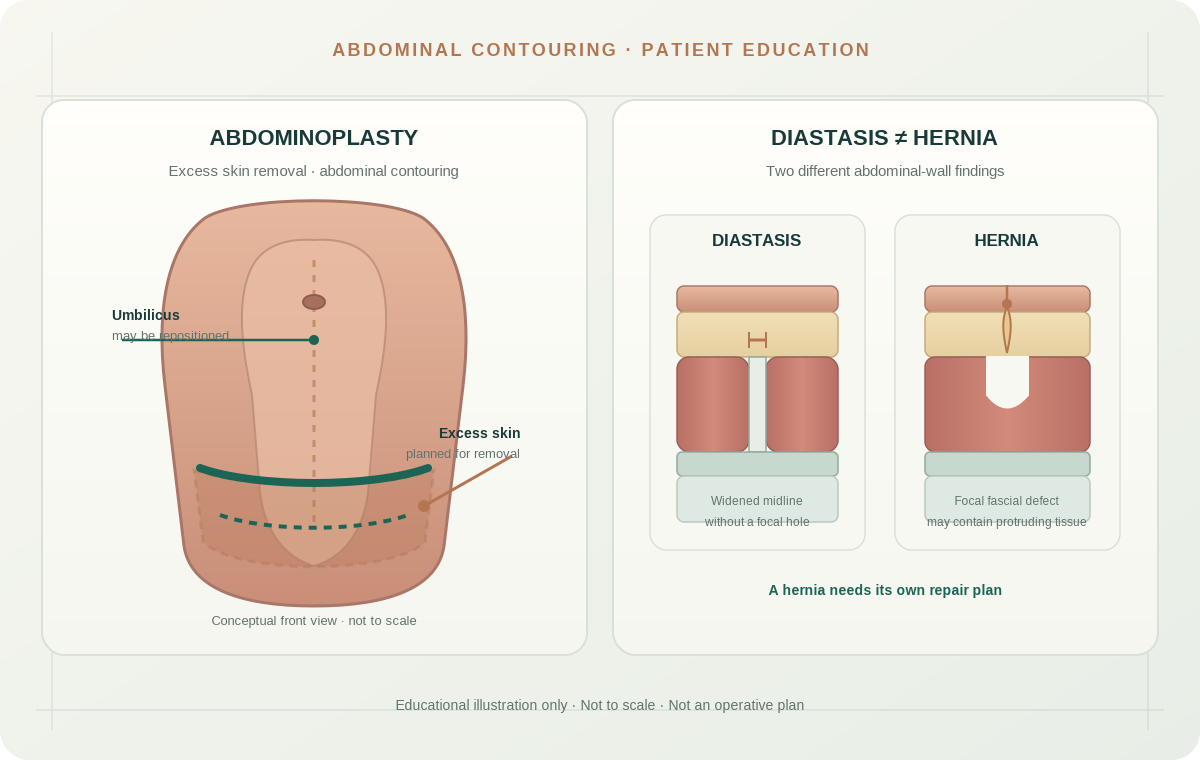
Abdominoplasty removes excess abdominal skin and some fat to improve abdominal contour. It may also include plication of the rectus sheath when the muscles are separated. It is not a weight-loss operation and is not, by itself, a hernia repair. If a true hernia is present, it must be assessed and planned for separately; a combined operation may be considered in selected patients after weighing the risks and benefits.
How is the operation performed?
-
Assessment and goals
The team reviews medical history, previous operations, weight changes, pregnancy history, medicines and smoking or nicotine exposure. The skin, fat and abdominal wall are examined for muscle separation or a hernia. Imaging may be needed when a hernia is suspected or abdominal-wall reconstruction must be planned. Realistic goals, expected scarring and alternatives are discussed.
-
Selecting the type of abdominoplasty
The plan depends on the amount and location of excess skin, skin elasticity and fat distribution. Options may include a limited lower-abdominal procedure, a full abdominoplasty that usually involves repositioning the umbilicus, or an extended procedure in selected cases. Liposuction may be discussed as an adjunct, but it does not by itself correct excess skin, muscle separation or a hernia.
-
Managing excess skin and tissue
Incisions are planned to suit the patient’s anatomy and previous scars. During surgery, the skin and fatty-tissue envelope is reshaped and the planned excess is removed. The extent of tissue elevation and methods used to preserve blood supply to the skin and umbilicus vary with the operation and surgical history; there is no single plan for every patient.
-
Muscle plication or hernia repair when indicated
If rectus diastasis is present, the linea alba may be plicated after assessing symptoms and anatomy. A hernia is a true defect in the abdominal wall and requires its own repair plan; mesh reinforcement may be needed depending on defect size, location and patient factors. When combining abdominoplasty with hernia repair is considered, wound risk, skin blood supply and venous thromboembolism risk are reviewed. A single-stage or staged approach may be appropriate.
-
Redraping, closure and recovery
The skin is redraped and the incisions are closed; the umbilicus is positioned as required by the chosen operation. Drains or a compression garment may be used depending on the procedure and the surgeon’s plan; they are not identical requirements for every patient. After surgery, the team provides instructions for early mobility, wound care, follow-up and gradual return to activity.
What does abdominoplasty address?
Abdominoplasty aims to remove excess skin and some fat and improve abdominal contour. It may include tightening the rectus sheath when diastasis is present. It can address loose skin after pregnancy or weight loss, but it is not a substitute for weight reduction or obesity treatment and cannot guarantee a completely flat abdomen. A scar is an expected part of the operation.
Full, limited and extended abdominoplasty
The choice depends on the location and amount of excess skin, skin elasticity, abdominal shape and previous scars. A limited procedure usually addresses the lower abdomen in selected cases, while a full abdominoplasty treats a broader area and may require umbilical repositioning. In some patients the incision may extend toward the flanks. The surgeon should explain scar placement and the limits of each option before a decision is made.
Rectus diastasis is not the same as a hernia
Rectus diastasis is widening and thinning of the linea alba between the rectus muscles; it is not, by itself, a full-thickness hole in the abdominal wall. The European Hernia Society guideline defines diastasis as a separation wider than 2 cm, but the measurement alone does not determine whether surgery is needed. A hernia involves a fascial defect through which fat or abdominal contents may protrude. Both conditions can coexist and should be assessed separately.
Can abdominoplasty be combined with hernia repair?
A combined operation may be discussed in selected cases, but it is not an automatic choice. Planning depends on hernia size and location, feasibility of repair, mesh requirements, skin and tissue quality and blood supply, weight, nicotine exposure, diabetes and clotting risk. Combining procedures may suit some patients, while staging them separately may be safer for others. The team should explain expected benefits and the risks of wound problems, seroma, infection and thrombosis, including an alternative plan if needed.
Who may benefit from abdominoplasty?
The procedure may suit some people with excess or persistent loose skin, or muscle separation causing functional or aesthetic concerns, provided their general health permits surgery, their weight is stable and their expectations are realistic. It may be better to postpone surgery if major weight loss or a future pregnancy is planned, as either can change the result. Smoking and nicotine, diabetes, certain medicines and previous operations can affect wound healing and should be discussed before surgery. No single criterion fits everyone.
Potential risks and complications
Risks include bleeding or haematoma, infection, seroma, delayed wound healing or wound separation, compromised blood supply or loss of skin or fat, altered sensation or numbness, contour irregularity or unfavourable scarring, umbilical healing problems and possible further procedures. Anaesthetic complications and deep-vein thrombosis or pulmonary embolism are also possible. Risks may change when hernia repair or liposuction is added and should be assessed individually.
Preparation and recovery
Preparation includes reviewing chronic conditions, medicines and supplements, allergies, previous operations and nicotine exposure, with tests or medical assessment as advised by the team. Do not stop prescribed or blood-thinning medicines on your own. Thrombosis prevention is based on individual risk assessment and may include early mobilisation and mechanical or medication measures as appropriate. Recovery varies with the extent of surgery and whether abdominal-wall repair is added; the surgeon will advise when to drive, work, lift, exercise and resume normal activity.
What abdominoplasty cannot guarantee
Abdominoplasty is not a weight-loss method. It cannot prevent future weight gain or the effects of a later pregnancy, remove every stretch mark, guarantee perfect symmetry or eliminate the scar. It also cannot prevent hernia recurrence unless the hernia itself is repaired appropriately. Sudden severe abdominal pain, persistent vomiting or a painful irreducible swelling requires urgent medical assessment rather than waiting for a cosmetic appointment or routine follow-up.
Frequently asked questions
Does abdominoplasty repair a hernia?
No. Abdominoplasty removes excess skin and may include muscle plication, but it does not automatically close a hernia defect. A hernia needs its own assessment and repair plan; combining the procedures may be considered in selected cases.
Does rectus diastasis mean that I have a hernia?
Not necessarily. Diastasis is widening of the linea alba between the muscles, while a hernia involves a fascial defect. They can coexist, so examination is needed to identify each condition separately.
Are the abdominal muscles tightened in every tummy tuck?
No. Rectus sheath plication may be added when diastasis is present and it is appropriate after assessment. The plan depends on anatomy, symptoms and goals; plication may not be needed or suitable for every patient.
Can abdominoplasty and hernia repair be performed together?
It may be possible in selected cases, but combining procedures can increase operative complexity and wound or seroma risks. The team decides whether a single-stage or staged approach is more appropriate.
Is abdominoplasty a weight-loss operation?
No. It removes excess skin and improves contour, and may remove some fat, but it does not treat obesity or replace a weight-management plan. Weight is generally best kept stable before surgery.
What are the main risks and how long is recovery?
Risks and recovery time vary with the procedure, the patient’s health and whether a hernia is repaired at the same time. Risks include seroma, infection, wound-healing problems, altered sensation and blood clots. The surgeon will provide an individual plan for mobility and return to work, exercise and lifting.