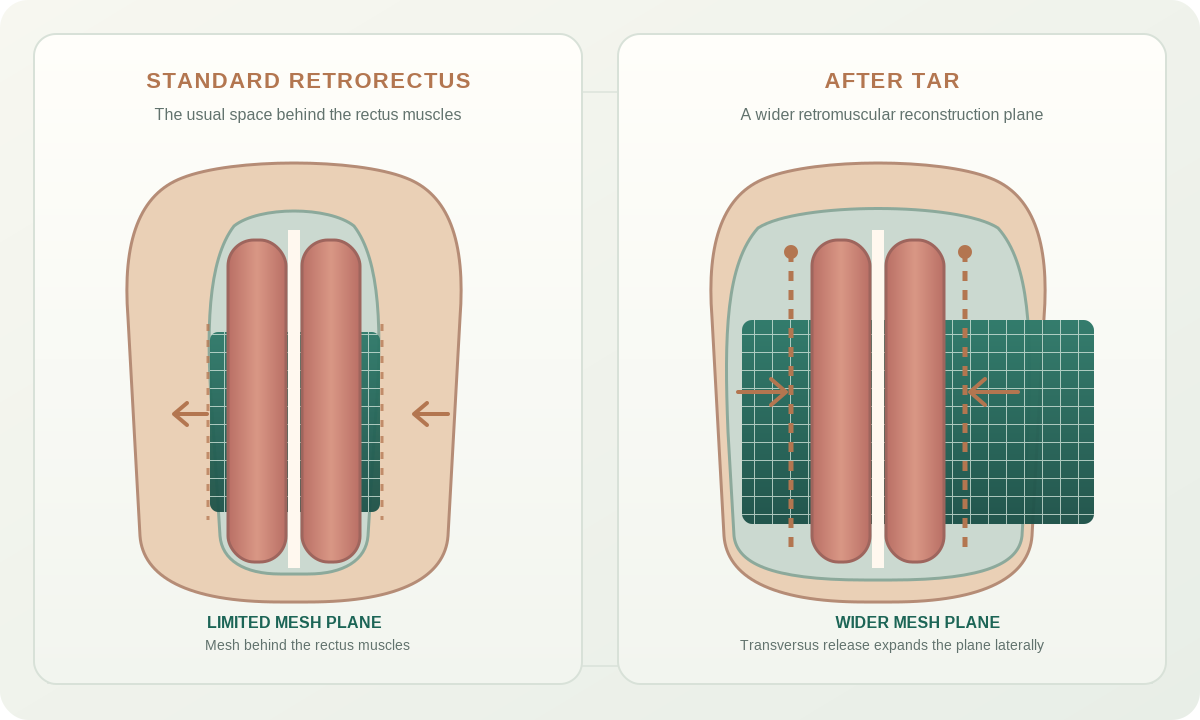
TAR is a form of posterior component separation considered for selected large, recurrent or complex ventral and incisional hernias when the standard retromuscular space alone may not provide enough mobility for appropriate midline closure. Releasing the transversus abdominis muscle expands the reconstruction plane and allows broad mesh reinforcement behind the abdominal muscles, while aiming to restore abdominal-wall continuity. It is an advanced operation and is not needed for every hernia.
How is the operation performed?
-
Assessment and planning
The team reviews symptoms, previous operations, examination findings and imaging. A CT scan may be requested to map the defect, its location and the surrounding muscles and tissues. Risk factors such as smoking, diabetes, nutrition, weight and medicines are also reviewed. This information supports planning, although the final need for muscle release may also depend on operative findings.
-
Developing the retromuscular plane
The surgeon accesses the plane behind the rectus muscles and develops the working space. Tissue is separated carefully while protecting important blood vessels and nerves that supply the abdominal wall. The access method may differ between open surgery and selected minimally invasive approaches, depending on the case and the team’s expertise.
-
Releasing the transversus muscle and extending the plane
When additional space is needed, the surgeon releases the transversus abdominis muscle from the posterior side. This allows the reconstruction plane to extend farther laterally and helps mobilise the posterior layer toward the midline. The extent of release may differ between sides and according to where extra movement is needed; every case does not require an identical or complete release.
-
Reconstructing the posterior layer and placing mesh
After the required space has been developed, the posterior layer is brought together or repaired to create a barrier between the mesh and the bowel and other abdominal organs whenever this can be done safely. A suitable mesh is then placed with broad coverage in the retromuscular or preperitoneal plane. The surgeon selects the mesh type, size and handling according to the anatomy and the individual case.
-
Restoring the midline and completing the repair
The aim is to bring the front layer of the abdominal wall together and restore the midline when this can be achieved without undue tension, with the mesh remaining behind the muscles. The closure and tissues are checked, and drains may be used in some cases. Operative details, follow-up and length of stay vary with the size of the reconstruction and the patient’s health.
What is TAR?
TAR stands for Transversus Abdominis Release. It is a form of posterior component separation in which the surgeon expands the space behind the abdominal muscles by releasing part of the transversus abdominis muscle. This creates a wider area for mesh placement and helps mobilise the abdominal-wall layers toward the midline. The aim is to reconstruct the wall rather than simply bridge the defect with mesh.
What problem can TAR help address?
In some large or recurrent incisional hernias, the abdominal-wall edges are far apart or under tension, and the usual space behind the rectus muscles may not provide enough movement for appropriate closure. TAR extends the posterior plane and may help bring the layers toward the midline while allowing a large mesh to be placed behind the muscles. It does not guarantee that closure will always be possible or that recurrence can be eliminated.
Who may be considered for TAR?
TAR may be discussed for selected large or recurrent incisional hernias, wide abdominal-wall defects and some complex cases involving loss of domain or the need for advanced reconstruction. It is not usually used simply because a small or straightforward hernia is present. The decision depends on defect size and location, previous operations or mesh, muscle and tissue condition, general health and whether appropriate closure can be achieved with a simpler repair.
How does TAR differ from Rives–Stoppa repair?
Rives–Stoppa repair places mesh in the space behind the rectus muscles and does not routinely require release of the transversus abdominis muscle. TAR starts from the same retromuscular plane and extends it farther laterally by releasing the transversus muscle when additional space and movement of the posterior layers are needed. TAR is therefore an advanced extension of retromuscular repair, not a necessary replacement for it in every case.
How does posterior differ from anterior component separation?
TAR works behind the abdominal muscles and releases the transversus abdominis from the posterior side. Traditional anterior component separation releases the external oblique muscle through a more superficial lateral plane and may require extensive soft-tissue dissection. The posterior approach may avoid some of that superficial dissection, but it remains a complex operation with its own risks and cannot be assumed to be safer for every patient.
What are the potential advantages and limitations?
TAR may provide a broad retromuscular plane for mesh placement and help bring the abdominal-wall layers together to restore the midline in selected complex hernias. It can also keep the mesh outside the peritoneal cavity when the posterior layer can be closed safely. On the other hand, it requires specialist expertise, time and careful planning, and may not be suitable when tissue condition or general health does not support a major reconstruction. No single technique is best for every patient.
What are the possible risks and complications?
Possible complications include bleeding, infection, fluid collection, delayed wound healing, pain, recurrence or mesh infection. Bowel injury may occur during adhesiolysis, and blood vessels or nerves supplying the abdominal wall may be injured. Nerve injury can lead to weakness or a lateral bulge. Major reconstructions can also involve problems related to increased abdominal pressure or breathing. Risks vary with the patient and the extent of surgery and should be discussed with the surgeon before a decision is made.
How is the operation planned and prepared for?
Planning may include a clinical examination, CT imaging and review of previous operations and the position of any existing mesh. Improving health before surgery may reduce some risks; this can include diabetes control, stopping smoking, improving nutrition, reviewing weight and medicines, and respiratory fitness. Do not stop blood thinners or any prescribed medicine on your own; follow the instructions of your surgeon and anaesthetist.
What is recovery like after TAR?
Because TAR is often used for major reconstruction, a patient may need a hospital stay and monitoring of the wound, pain, mobility, bowel function and breathing. Gradual movement is encouraged according to the team’s instructions, and drains may be used in some cases. Length of stay and return to work, sport and lifting depend on the extent of repair, access method and general health. The surgeon will provide an individual follow-up and activity plan. Seek urgent medical assessment for worsening severe pain, persistent vomiting, increasing abdominal swelling, fever, wound redness or discharge, or shortness of breath.
Frequently asked questions
Is TAR the same as Rives–Stoppa repair?
No. Both use the retromuscular plane for mesh placement, but TAR adds release of the transversus abdominis muscle to extend the space laterally when extra movement of the posterior layers is needed.
Does every patient with an incisional hernia need TAR?
No. Many hernias can be repaired with simpler methods. TAR is considered when the usual retromuscular space is not sufficient or when the case requires advanced reconstruction.
Is the mesh placed inside the abdomen next to the bowel?
The usual aim in TAR is to place the mesh behind the abdominal muscles in the retromuscular or preperitoneal plane, not inside the peritoneal cavity. The posterior layer is closed whenever this can be done safely to separate the mesh from the viscera.
Is TAR always performed on both sides?
Not necessarily. Some patients may need release on both sides, while the plan differs in others according to the defect location and the movement required. The surgeon determines the appropriate extent for each case.
Does TAR guarantee that the hernia will not recur?
No operation can guarantee that a hernia will never recur. Outcomes are influenced by defect size, tissue condition, general health, healing, technique and follow-up, so monitoring continues after surgery.
How long are the hospital stay and recovery?
The timeline varies considerably with the size of the reconstruction, access method, general health and any complications. A major repair may require a longer stay and follow-up than a straightforward hernia operation. The team will individualise the timing of mobility and return to work, sport and lifting.