
Open surgery is a way of reaching a hernia through a direct incision; it is not one single operation. Repair of an inguinal hernia differs from repair of an umbilical or incisional hernia, and the mesh plane and method of closing the defect vary with anatomy, previous operations and the patient’s health. The surgeon selects an approach after assessment and discussion of alternatives.
How is the operation performed?
-
Assessment and planning
The team reviews symptoms, examination findings, previous operations, medicines and risk factors. Examination may be sufficient for some hernias, while CT imaging may be requested to map the size and contents of an incisional or complex hernia. The incision, anaesthetic and repair plan are selected for the individual case.
-
Accessing the hernia and assessing its contents
The surgeon reaches the hernia directly through an incision suited to its location. The tissues are carefully separated and the hernia sac is managed as needed; its contents are returned when this is safe. Previous operations may leave adhesions or scarred tissue that require careful handling.
-
Choosing how to close the defect
The surgeon assesses the edges of the defect, tissue quality and whether the fascia can be brought together without undue tension. Suture repair may be used in selected cases, while many hernias benefit from mesh reinforcement to reduce recurrence. The decision differs between inguinal, umbilical and incisional hernias; one rule does not fit every patient.
-
Selecting the mesh plane when mesh is used
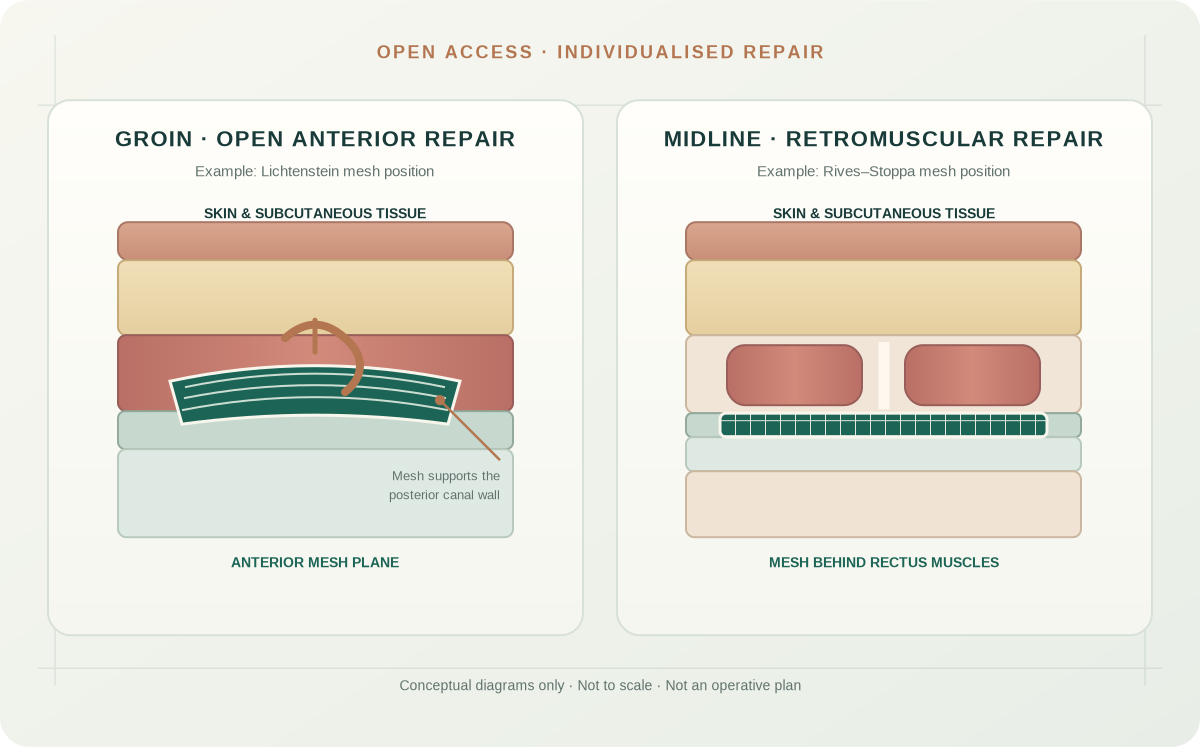
Mesh position depends on the hernia and anatomy. It may be placed anteriorly in the inguinal canal for a Lichtenstein repair, preperitoneally for selected umbilical hernias, or behind the rectus muscles for a midline incisional hernia repair. Each plane has different considerations; the surgeon selects the mesh and fixation method as part of the plan.
-
Checking the repair and closing the wound
The repair is checked and bleeding is controlled before the wound layers are closed. A drain may be used in some larger operations when the surgeon considers it appropriate; it is not required routinely for every patient. The team then provides an individual plan for mobility, wound care, gradual return to activity and follow-up.
What does open hernia surgery mean?
It means the surgeon reaches the hernia through a direct incision rather than relying only on laparoscopic ports. The word “open” describes the route of access; it does not, by itself, define the repair technique or mesh plane. Different open operations are used for inguinal, femoral, umbilical, incisional and complex ventral hernias.
Open inguinal hernia repair
A well-established option is the Lichtenstein repair, in which a flat mesh is placed anteriorly over the posterior wall of the inguinal canal and beneath the external oblique layer that is closed over it. Open preperitoneal techniques are also available. A tissue-only repair, such as Shouldice, may be discussed for selected patients when appropriate expertise is available. None of these options is best for everyone; selection depends on hernia type, sex, previous operations, patient factors and surgeon experience.
Open umbilical and epigastric hernia repair
Many umbilical and epigastric hernias can be repaired through a small incision near the defect. In many cases, a flat mesh is placed in the preperitoneal plane to reduce recurrence. Suture-only repair may be discussed for very small defects, particularly those under 1 cm, after considering its benefits and limitations with the surgeon. Larger defects or patients at higher risk of wound problems may require a different approach.
Open incisional hernia repair and abdominal-wall reconstruction
A midline or large incisional hernia may require careful release of tissues around the defect and restoration of the abdominal-wall layers. For many midline incisional hernias that can be closed without advanced muscle release, European Hernia Society guidance recommends retromuscular mesh placement, fascial closure and avoiding mesh bridging where possible. Larger or more complex hernias may require advanced techniques such as TAR and should be managed by a team with appropriate expertise.
Where can the mesh be placed?
Mesh position depends on the hernia and the available tissue planes. In Lichtenstein repair the mesh lies anteriorly over the posterior wall of the inguinal canal. In some umbilical repairs it is placed preperitoneally. In a Rives–Stoppa repair it lies behind the rectus muscles and in front of the posterior layer. Other planes, such as onlay or intraperitoneal placement, are also used in selected circumstances but are not interchangeable or equally suitable for every case. The plane matters as much as the mesh choice.
Open surgery or laparoscopy?
No single approach is best for every hernia. For some primary unilateral inguinal hernias, HerniaSurge guidance recommends a laparo-endoscopic approach when specialist expertise and suitable resources are available, because it can reduce chronic pain and speed recovery; however, patient and hernia factors may make open repair more appropriate. For ventral or incisional hernias, selection depends on defect size and location, previous operations, wound risk, team expertise and available techniques. The surgeon should discuss the benefits, risks and alternatives before a decision is made.
Risks and longer-term considerations
Potential risks include bleeding, infection, haematoma or seroma, wound-healing problems, persistent pain or numbness, and recurrence. Mesh-related complications such as infection or the need for another intervention can occur; the risk of bowel or organ injury also varies with the hernia and operation. Smoking, diabetes, weight, nutrition, previous operations and tissue condition can influence risk. Your surgeon should explain the risks relevant to your circumstances.
Preparing for surgery and recovery
Optimising diabetes control, stopping smoking, improving nutrition and weight, and reviewing medicines may reduce some risks, depending on your circumstances and the team’s advice. Hospital stay and return to work or activity vary with the size and type of repair and your general health. Follow your surgeon’s instructions for wound care, lifting and physical activity. Seek prompt medical assessment for increasing severe pain, fever, persistent vomiting, worsening redness or wound discharge, or sudden swelling.
Frequently asked questions
Is open surgery an outdated method?
No. Open surgery remains an important part of hernia care and includes modern techniques and different mesh planes. The choice depends on the individual case, not simply on whether the approach is open or laparoscopic.
Does open surgery mean I will not need mesh?
Not necessarily. Suture repair may be appropriate in selected cases, while many hernias benefit from mesh reinforcement to reduce recurrence. The decision depends on the hernia type and size, tissue quality and patient factors.
Is Lichtenstein the same as Rives–Stoppa repair?
No. Lichtenstein is an open groin repair in which mesh is placed anteriorly over the posterior wall of the inguinal canal. Rives–Stoppa is an abdominal-wall repair in which mesh is placed behind the rectus muscles in the retromuscular plane.
Is open surgery better than laparoscopy?
There is no single answer for every patient. Laparoscopy may offer benefits in selected cases, while open surgery may be more suitable in others because of the hernia, previous operations, patient factors or team expertise.
Does every incisional hernia need TAR?
No. TAR is an advanced technique used for selected large or complex hernias when the standard retromuscular space is not sufficient for reconstruction. Many incisional hernias can be repaired without releasing the transversus abdominis muscle.
How long does recovery take after open repair?
Recovery varies with the hernia location, extent of repair, general health and type of work. A straightforward repair is very different from complex abdominal-wall reconstruction. Your surgeon will guide follow-up and a gradual return to activity and lifting.